
Clay County Criminal Court Cases
Iowa District Court is the main trial court for Clay County criminal court cases. It handles felonies and indictable misdemeanors, while magistrate functions within the unified district court cover simple misdemeanors and early proceedings. Iowa cities do not run a separate criminal court system like the municipal courts found in some states. A Spencer ordinance or city arrest that becomes a state criminal charge therefore enters the Iowa court structure. The public docket and the Clay County Clerk of Court are the main court-record channels.
The clerk keeps dockets, filed charging papers, orders, judgments, and copy records at the Clay County Courthouse. The arresting agency keeps its own incident report, and the Clay County Attorney keeps prosecution office records. Those files overlap, but none replaces the others. A person seeking a judgment or certified case copy should start with the clerk, not the sheriff. Clay County is part of Judicial District 3A.
Iowa Search for Clay Cases
Iowa Courts Online provides the statewide public trial-court index. Its basic docket search is free. Account access or fees may apply to advanced features and documents. Select Clay County when a common name produces cases from across Iowa. A case number is the strongest key because it follows the file through later clerk requests, prosecutor references, and an expungement inquiry.
The official search screen can change. The image from the Iowa Courts Online search shows the state system used for Clay County criminal case records.
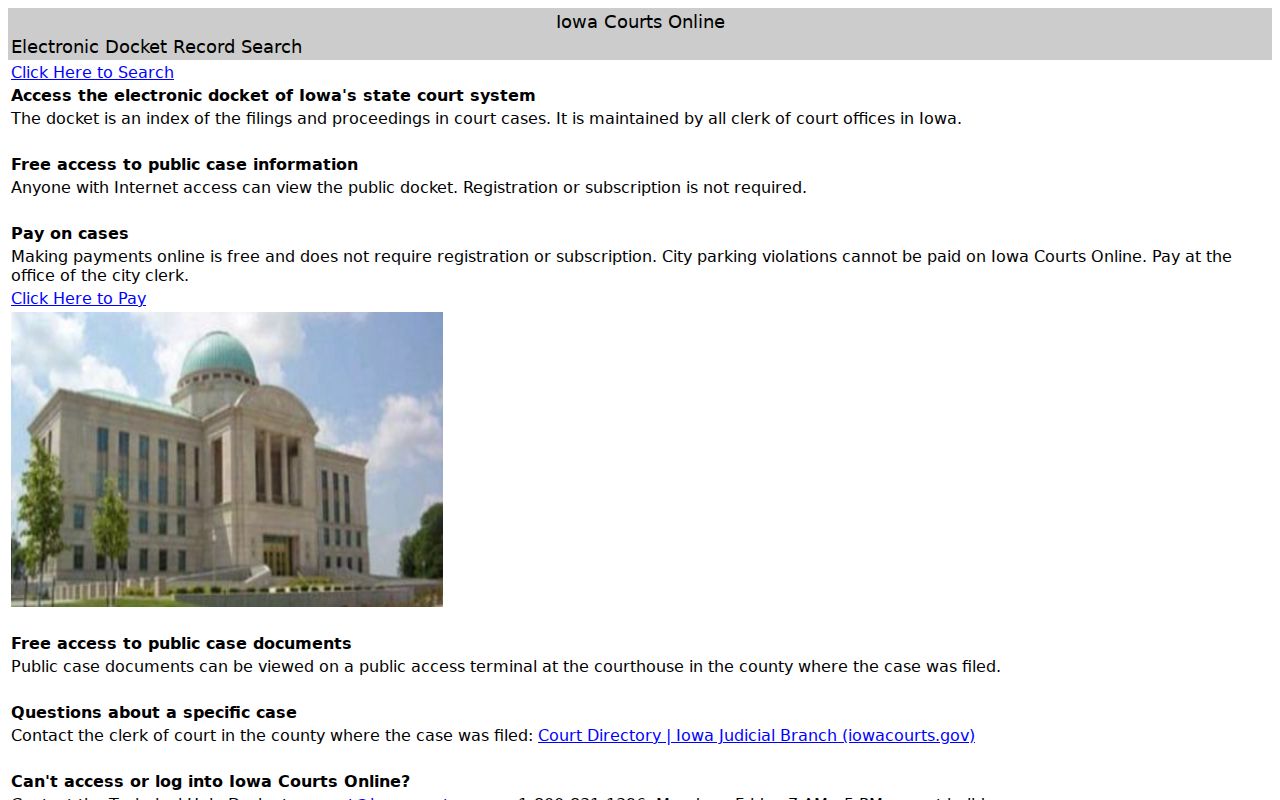
This statewide view is the right first stop for a filed Iowa case, but it does not promise a downloadable copy of every pleading or order.
Searching Clay County Case Records
Begin online, then move to the clerk when the public index is incomplete or the needed paper is not available. Search by party name only when the case number is unknown. Spelling, a former name, and filing year can affect results. The state help materials describe schedule and advanced case searches, but current on-screen labels control.
- Open Iowa Courts Online and choose the case or advanced search mode.
- Enter the case number, or search the last and first names used in court.
- Select Clay County and narrow by case type or date range when those controls appear.
- Open the matching docket. Compare the filing date, charge, party, status, and event list.
- Call the Clay County Clerk for a full pleading, archive file, judgment, or certified copy.
The portal exposes several ways to narrow a search. None alone proves that a case does or does not exist.
| Field Label | Type | Required | Notes |
|---|---|---|---|
| Search mode | Tabs or links | No | Case, schedule, and advanced routes serve different needs. |
| Case Number | Text | No | Best unique identifier when known. |
| Last or Business Name | Text | Mode dependent | Use the exact court spelling. |
| First Name | Text | No | Narrows common names. |
| County | Dropdown | No | Choose Clay for local cases. |
| Case Type | Dropdown | No | Select criminal when the option appears. |
| Date Range | Date fields | No | Useful for schedules and events. |
Note: A schedule entry is not necessarily a trial date, and an online screen print is not automatically a certified court record.
Clay County Case Copy Fallback
Call the Clay County Clerk of Court at 712-262-4335 when a case is missing, old, or not fully available online. Give the full name used at the time, approximate filing year, case number if known, and the exact item needed. Ask whether the file predates online coverage, is archived, was transferred, or has a confidential or expunged status. Also ask about retrieval time and current copy or certification cost. No official local fee schedule was found, so a price should not be assumed.
Clay County Clerk of Court
215 W. Fourth St.
Spencer, IA 51301
712-262-4335
The county’s direct phone list confirms the clerk line. The Iowa State Public Defender explains the state indigent-defense system.

The pictured state defense resource also matters because appointed counsel is requested through the court, not from the prosecutor.
Inside a Clay County Case File
A Clay County court file centers on one filed matter. It differs from a DCI rap sheet, which compiles legally releasable events across Iowa, and from a jail record, which centers on one period of custody. The docket may list State of Iowa as plaintiff and the accused person as defendant. Protected contact details, Social Security numbers, juvenile matters, and sealed material stay out of public view.
| Case Number and Court | Unique file key, county, and case category. |
|---|---|
| Charging Document | Complaint, trial information, or indictment that states the filed accusation. |
| Docket Entries | Dated filings, motions, orders, pleas, warrants, and other procedural events. |
| Hearing Dates | Past or scheduled court events, which are not all trials. |
| Disposition and Judgment | Dismissal, acquittal, plea, guilty finding, deferred judgment, or other outcome. |
| Sentence and Money | Sentence, fine, surcharge, court cost, restitution, payments, and balance when public. |
Bond and a financial judgment are not the same. Bond concerns release before the case ends. A fine, cost, restitution award, payment, or balance belongs to the court’s financial record after filing or disposition.
Why Clay County Charges Change
The charge written at booking may not match the final Clay County criminal case. Police record the suspected offense at arrest. The Clay County Attorney then reviews the facts and chooses what, if anything, to file. A later plea can amend the charge again. The prosecutor’s office is at 505 Second Avenue West, Suite A, rather than in the courthouse, and it is not the custodian for certified court copies.
The Clay County Attorney’s official page describes the office that prosecutes state crimes and county ordinance violations.
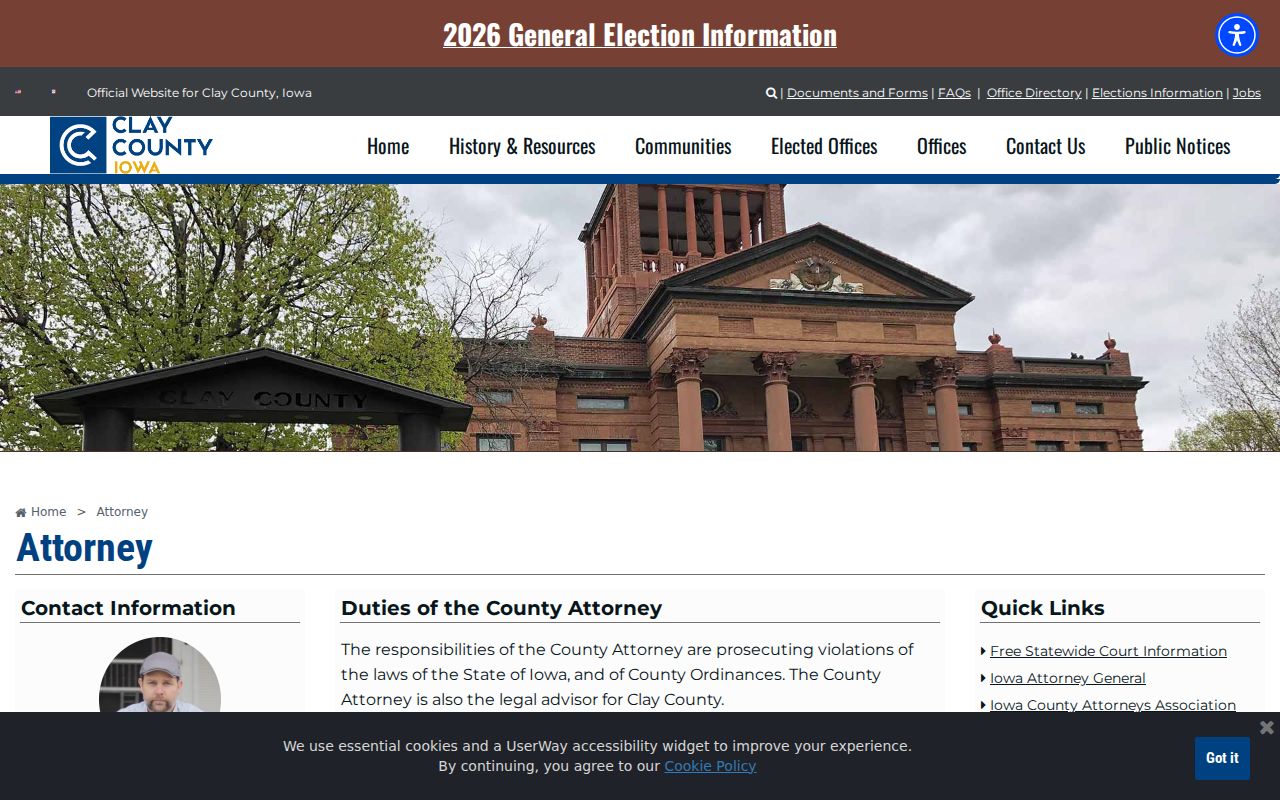
This split explains why a jail charge, filed charge, and disposition can use different words without being different people or unrelated events.
How a Criminal Case Moves
After an arrest or citation, an initial appearance addresses the accusation, rights, release conditions, and scheduling. The prosecutor may then file a complaint, trial information, or pursue an indictment for an indictable matter. Arraignment is the formal point when the defendant responds to the filed charge. Discovery, motions, negotiation, and hearings follow. The case ends through dismissal, plea, trial verdict, or another lawful disposition, with sentencing after a guilty result unless judgment is deferred.
Case flow: Charges Filed › Arraignment › Pretrial › Plea or Trial › Disposition › Sentencing
Event labels describe procedure. “Pending” means no final disposition has been entered. It does not forecast guilt. A warrant entry may reflect failure to appear or another order inside the same case.
Clay County Court Terms Decoded
Outcome words can change what a court record means. They should be read with the charge status and judgment, not as loose labels.
- Dismissal
- A charge ended without a conviction.
- Acquittal
- A not-guilty verdict after trial.
- Deferred judgment
- Judgment is withheld while court terms are completed; Iowa gives it special court and DCI treatment.
- Disposition
- The final result recorded for the charge or case.
- Restitution
- Court-ordered payment for a qualifying loss.
A discharged deferred judgment may be expunged from ordinary court display yet remain at DCI as a non-conviction released only with signed authorization. A person reviewing their own record should compare both systems. Iowa Code chapter 901C controls qualifying expungement, while the clerk can explain the filing route for the original Clay County case.
Case-number prefixes may hint at a criminal category, but readers should not guess from letters alone. Iowa dockets can use labels associated with felony, aggravated misdemeanor, serious misdemeanor, or simple misdemeanor files. The live case type, charge row, and Iowa Code citation give better context. Severity also affects which judicial officer handles a stage, but every local file remains within Iowa’s unified district court. When a code is unclear, give the full case number to the Clay County clerk and ask what the public label means.
Case Record Access & Restrictions
Iowa’s open-record framework does not make every court detail public. Juvenile cases are generally confidential. Sealed and expunged cases, Social Security numbers, protected victim information, and other restricted identifiers do not appear in the ordinary public view. A missing online result can also mean an archive issue, a spelling mismatch, transfer, or delayed entry. Contact the clerk before drawing a conclusion.
Ask for the exact paper required: docket sheet, complaint or trial information, sentencing order, judgment, dismissal, or certificate of disposition. A certified copy bears the clerk’s certification and may cost more than a plain copy. The clerk should confirm the current amount. The sheriff cannot certify a court judgment, and DCI cannot rewrite one.
Clay County Federal Case Records
Federal charges arising in Clay County do not appear in Iowa Courts Online. Clay County lies in the U.S. District Court for the Northern District of Iowa, and federal dockets run through PACER. Registration and current usage fees may apply. This is a separate court system, not an appeal layer within the Clay County file.
The PACER access service provides the official federal docket route.
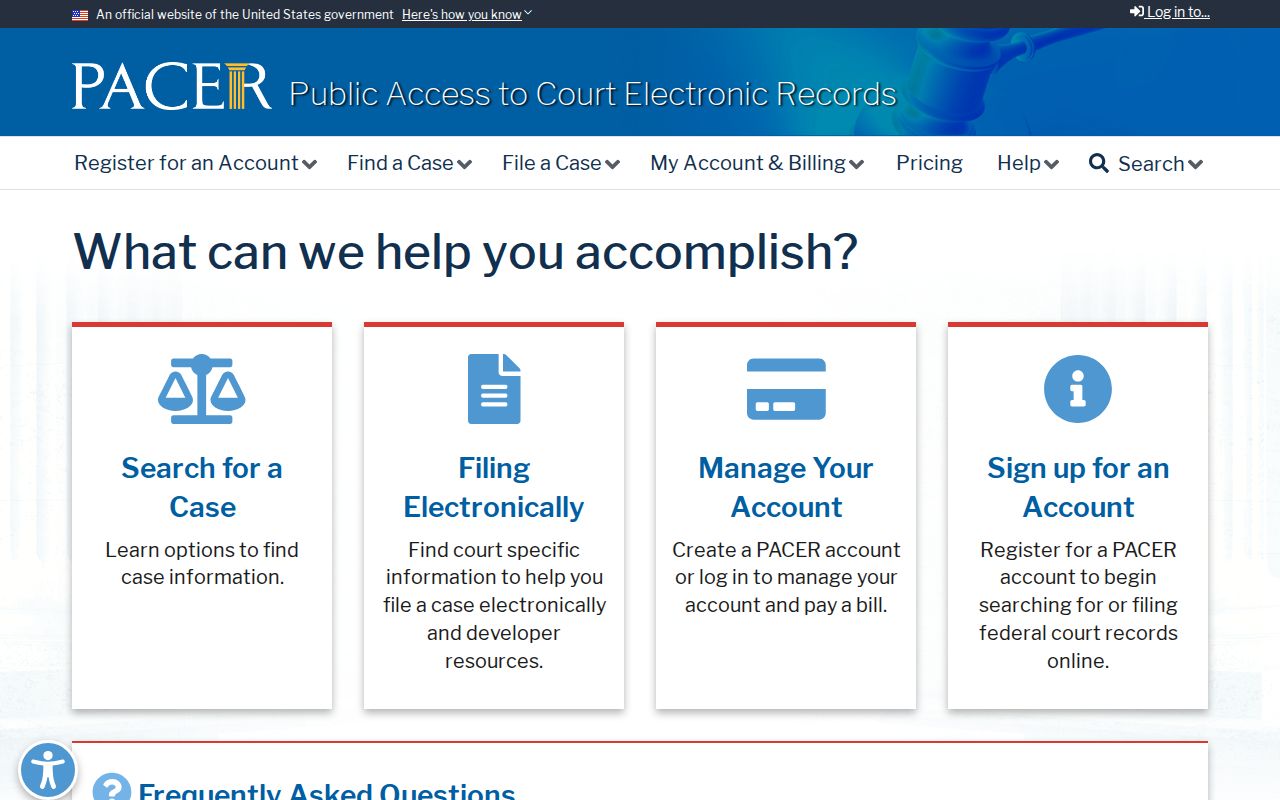
PACER may show filings, events, and documents allowed by federal access rules, while the district’s own site supplies office information.
The Northern District of Iowa website identifies the federal court serving the county.
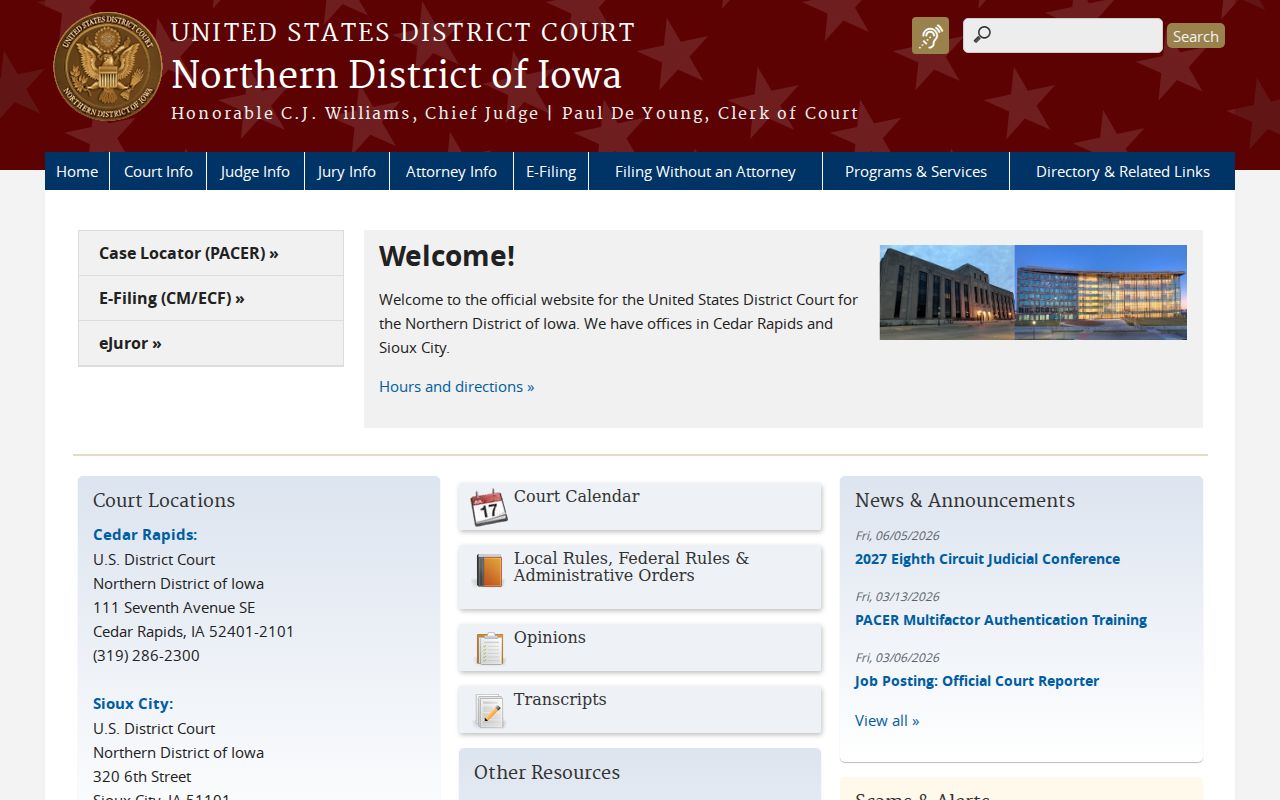
Use the federal case number when contacting that court, just as the state case number is the best key for the Clay County clerk.
Appeals also follow their own path. An Iowa state appeal moves through the Iowa appellate courts, while a federal appeal stays in the federal system. The trial docket may note that an appeal was filed, yet the later appellate orders and opinions can live in another record set. A searcher tracing the final result should follow the case number, appeal notice, and mandate rather than stop at the last trial-court event.